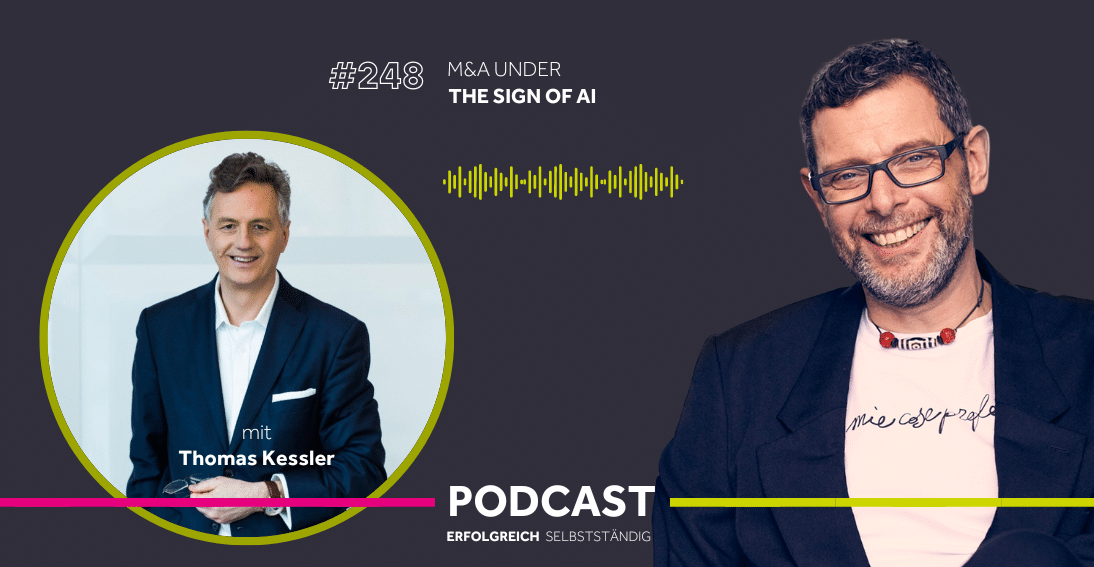
M&A under the sign of AI - In dialogue with Thomas Kessler
In this episode, which has been fully translated using artificial intelligence, we have a very special guest: Thomas Kessler, an experienced expert in M&A integration. With 28 years of experience, Thomas specialises in the integration of companies following mergers and acquisitions. He specialises in C-level executives in medium-sized companies.
In today's episode, we take a deep dive into the world of M&A transactions and the increasing role that artificial intelligence (AI) is playing. Thomas discusses how he uses AI to create more efficient and effective integration processes. AI applications can be extremely helpful in areas such as target company identification, market analyses, due diligence and contract clauses. They offer the potential to automate certain tasks, freeing up more time for human-centred activities.
One exciting aspect is the realisation that AI can be supportive in some areas of the M&A process, while human expertise remains essential in others. Thomas explores how AI can be used in practice and discusses the challenges and opportunities of its application in highly sensitive areas.
Another important point is the process of learning and adapting to AI. Thomas describes his own journey in dealing with AI, including adapting prompts and exploring AI tools. The discussion shows that the effective use of AI requires a deep understanding of the specific needs of the business.
Despite the technological advances, the human aspect remains crucial in M&A transactions. Thomas emphasises the importance of motivating and engaging employees to ensure the success of mergers and acquisitions.
Finally, Thomas talks about future prospects and developments in the M&A sector. He emphasises the need to continuously educate oneself and adapt to the latest developments in order to remain competitive. The role of AI is seen as an integral part of future M&A strategies.
Quick Links:
Sichere dir noch HEUTE eine Kopie unseres neuen Buches „chat GPT für Gen X"!
Dieses Buch ist dein Schlüssel, um dein Unternehmen oder deine Selbstständigkeit auf ein neues Level zu bringen. Lerne mit chatGPT, einem kraftvollen Assistenten, wie du deine Produktivität erhöhst, Zeit sparst und bessere Ergebnisse erzielst. Profitiere von praxisnahen Beispielen und konkreten Anwendungen. Unabhängig von deinem Kenntnisstand bietet dieses Buch wertvolle Einblicke und wird ein unverzichtbarer Begleiter für deinen Erfolg sein. Entdecke chatGPT und bereite dich optimal auf die Zukunft vor!
Buch … /shop/buch-mit-jedem-prompt-ein-wow/
Wenn du bereits in der Umsetzung bist oder es kommen möchtest, dann trete noch heute unsere Facebook Gruppe „Seilschaft der Selbstständigen bei. Komm mit anderem Selbstständigen ins Gespräch und lerne von ihnen!
Facebook Gruppe ... www.koerting-institute.com/ki-lounge/
Vereinbare jetzt einen persönlichen Umsetzungstermin mit uns ... in dem wir Deine Aktuelle Situation analysieren, betrachten wo Du oder Dein Team hinmöchtest, wir können aufzeigen, wie Du dahin kommst, was Dich aktuell davon abhält und was möglicherweise notwendig ist, um Dich einen Schritt weiterzubringen und damit Du Deine Ziele erreichst.
Wachstumssession ... www.koerting-institute.com/termin/
Wenn du auf der Suche nach weiteren spannenden Impulsen für deine Selbstständigkeit bist, dann gehe jetzt auf unsere Impulseseite und lass die zahlreichen spannenden Impulse auf dich wirken.
Impulse im Netflix Flow ... www.koerting-institute.com/impulse/
Wenn dir diese Podcastfolge gefallen hat, dann höre dir jetzt noch weitere informative und spannende Folgen…
Weitere Podcastfolgen ... www.koerting-institute.com/podcast/
Impressum: /impressum/
Das Transkript zum Nachlesen
The lawyers and attorneys are all still in the space of denial or in the space of shock and need, a little time to move into this space of confusion and acceptance. He was here at the AI Café for the first time two or three weeks ago and confronted us with a use case that I found very exciting from two perspectives. Firstly, from the perspective of the case itself, because it is very specific, because it is very specialised and perhaps interests one or two people in terms of the content. But who say that I don't have much to do with it? It's not my area of expertise. But the second focus is on the mechanisms that apply to this case and we are going to expose them today. One is the mechanisms that are then transferable to everyone in this room and the content is also super exciting and he is someone who is not afraid to share the screen and give us an insight into this case. Now, I'm delighted that you're here, Thomas Kessler. It's great that you're here. Thank you very much, Torsten. Thomas, before we start, I deliberately didn't mention it in the introduction, because I want to leave it up to you. Who are you? What problem are you solving and who are you doing it for? Tell us what you do. Hello, everyone. I've been working in M&A integration for 28 years, which means that company A buys company B and I help with the integration of these two companies. It can be functional. It's often with a project management element. But what's really important at the end of the day is that we've developed a structure of how we take people along from orientation, that they get involved, that they have a foot in the integration plan, to prioritization between day-to-day business and integration tasks. And that's a really important approach to be successful at the end of the day in a transaction like this, because you can imagine when companies, and especially small or medium-sized companies, buy other companies, we're not talking about hundreds of thousands. We're often talking about millions and millions. And when the big players do it, we're talking about billions. So these are transactions. There's a lot involved. And I learned that in 1995. That sounds a very, very long time ago when I was working in New York. And since then, I've done 46 of these integrations and have learned one thing or another and have developed an approach accordingly. And that was, of course, the question in your first session. What does that actually mean for me? And then you said, yes, then switch on the six pounds and think about how you can approach this. And then you divided up these nine steps sensibly, and I simply applied them. You also showed a picture. The bottom line was that you said, which process steps do you have? Which process steps could be AI-supported, which are not AI-supported? And I would just like to share that. Just look at it from a meta level. Not go into detail, because that's probably what the 51, 52 participants were for when I last looked. There are 56 right now. Yes, exactly. That may not be interesting for everyone, but I think the approach is actually what everyone who is here in the core can do for themselves and their company. And I would like to share that. Great. Thank you, Thomas, for the introduction. So we can see that you have been an expert in a very special niche for decades, you could say, namely company mergers, i.e. merchant acquisitions. And you have already accompanied a double-digit number of them. And the first question to take everyone along again, because you can also do this for yourselves. We have developed a canvas for this, which makes the whole thing a bit more accessible. I simply ask you these questions, you answer them so that we can uncover these new areas for everyone and also put them into your context. And then I would paint the picture again, which I gave you as a homework assignment, so to speak, namely the process steps, and then consider again where AI can support and where not. Because everyone can do that for themselves and in the context of their customers. And that is very exciting. Now, let's start with the new building blocks, with these new building blocks that make this use case that you have brought here tangible for everyone. In two or three words, who are you, Thomas? Are you an expert in? M&A integration expert with 46 M&A transactions and integration is a wealth of experience. It would be exciting if the GPT were written in here right now, but I'm doing it by hand. Even mine is just for me, even if you can't read it, just so that you can follow it in a structured way. What do you want? What do you want to achieve? What is the target state or what could describe the results you want to achieve, Thomas? To realize at a high level what my most important M&A process steps are, but I ultimately know that. More importantly, where will AI influence my business? So to clarify the process steps again at a high level and where will AI influence the process steps? I'll shorten that to process steps. So the impact or influence on the one hand and where can it possibly also provide effective and useful support? Effective and meaningful support. The questions I just asked Thomas are now also available in the chat. You can also go through them for your own use cases. We are also offering everyone. You have the same opportunity as Thomas that you are welcome to post your use case here in the chat. Whether we take it today or in the next one, two or three weeks that we then see how it fits in terms of time. But we can also either mirror your use case here, live on stage as we did with Thomas or solve it straight away. And that can now Toshi has shared his screen here. Now we're back. That's good that we can then solve it live and maybe give one or two more impulses. Great. For whom is this relevant? This clarity or this support of the corresponding or also the influences of artificial intelligence? So apart from you, of course, for Thomas, who else is it relevant for? Yes, my target group is C-level executives. For example, board members and managing directors of companies with a turnover of 100 million to 1 billion and 200 to 1000 employees. So in that order of magnitude, because sometimes you can't necessarily define it in terms of turnover alone. You also have to define it in terms of people. Tell me how many employees? The number of employees is typically between 200 and 1000, which is my sweet spot. Great. Do you have an industry orientation where you say that's my sweet spot in the industry? No, I'm an industry diagnostician. I just bring in the experts from the industry. If not, then I get them. Okay. Industry diagnosis. Super. Great. Top. Mega. What is the benefit once the result is there? Well, if you have this clarity about the process steps, you already have that. You also have clarity about where AI can provide effective support. What is the difference then? What is the benefit for you and your target group? So what I'm advocating here is a human-centric approach, which means that I'm concerned with people, picking people up, inspiring people, and then setting the right priorities and pushing the whole thing in the right direction so that the transaction is successful. Because when there is so much money involved, there is often also debt involved, and you simply need a successful approach. My interest is how can I implement this, but also supported by an AI, because an AI is faster in some things. In some things, perhaps also, I don't want to say more precise, but it can incorporate more points, incorporate more data points. And that is extremely important for the decision-making process for the C-Levelers, i.e. for my target group, because I then have the opportunity to no longer have to concentrate on the analysis, but I can concentrate on the people and on what counts at the end of the day, because companies are still people and companies are not machines. Great, so that gives you space that you don't need or use in wellness oases or for the penetration of any link in visibility, but for the people in the context of the transaction and in the context of all the activities that are necessary to enable this human-centric approach for a successful transaction. So it gives you more freedom to focus more or more deeply on people than you might have done before. And, of course, my target group. Great, tip-top, yes, I'm referring to both. Very good. Why might that be important? So why we already have this human-centered approach, we can definitely incorporate it here, so you can focus more on people. Are there any other reasons why you realize that this is a driver and a trigger for you to tackle this use case? Ultimately, we know from the field of leadership that if I define a clear purpose for my company, in other words, a clear why, a clear goal for my company and communicate this well, then I can actually inspire the people in the company and then they are committed to the company. That is a typical recipe for success because I am able to overcome difficulties, to make pivots, so to speak, to tackle new opportunities that I might not otherwise have. This enthusiasm is very important. Hilti once said that enthusiastic employees create enthusiastic customers. And that's actually a really great sentence that Hilti formulated there. And it's important to me because ultimately there are always difficulties when integrating two companies. There's never a transaction where there wasn't a problem somewhere, but taking people along with you. This is extremely important because I am then also in a position to steer these people in the right direction and solve the problems. Very good. Thank you, Thomas. What skills, basic knowledge, problem awareness and willingness do you already have in the working group to approach artificial intelligence? As we have just heard from Toschi, the lawyers and attorneys are all still in the space of denial or in the space of shock and need, a little time to move into this space of confusion and acceptance. To talk about Glass-Janssen's four spaces of change. What do you already have that you can build on and what is perhaps missing to make this path that you want to take here possible? Firstly, there is a pro account. So that's good. That's a good thing. I've been fascinated for a few months now, experimenting around, learning quickly and seeing what I actually, yes, what I just don't know yet. And what is also clear is that there are a number of tools that are already on the market. There are project management tools that are supported by AI. There are due diligence tools that are supported by AI. AI can be used for forecasting topics, for example, whether it's a market and whether it's the development within this market, the forecast of a company and its sales. There is a whole range of tools for this. I am in dialogue with some of them to do a product review where I look at the product and say, is it interesting? Is it not interesting? And then write about it and report on it. So there is that. But there are so many things that I simply don't know about yet. So I'm absolutely aware of that. And I know that I really have to and will have a steep learning curve in the next year in order to be able to really get ahead in my business. Do you already feel a certain competitive pressure that your market competitors, who are perhaps similarly positioned to you and also have a similar history, are also already dedicated to this field and are perhaps even two or three chapters ahead of you? Or do you feel that you are actually the one who is so far ahead? That's a very good question. And if I preface my answer like that, it usually means that there are a whole range of people who are already very advanced. So the big four, PVC, KPMG, EY, of course, they've all been focusing their AI teams on this topic for a long time. There's no question about it, especially because they do this on a huge scale every day worldwide. And not just in Germany or in my case, it's not just in Germany, but they still have their teams. Are they able to see a lot of things that I, as a smaller company, might be able to see with my team? I can't really see that. The only thing that is important and what I see also in dialogue with former colleagues from these big four or the other consulting firms that are there is that ultimately everyone is approaching this topic. And if you don't approach this topic, but instead close yourself off to it, I think you will fall behind at some point at the end of the day. So to be there early enough, perhaps not yet, to claim that you are riding the wave, but at least to be at the front of it and to know that you are on the tightrope, that you are hanging on, that you are not in danger of falling off somehow, but that you are dealing with these issues. You also decided to take the AI Masterclass with us. Based on your intention, we said, I'll say two or three more sentences in a moment, that we would also be launching an AI Masterclass specifically for consultants next year. You were the first and you were the trigger for us to do this, which is designed a little differently and focused on these use cases and to be on this rope and to know that I'm at the front and I'm not somehow lagging behind. Great. Thank you, Thomas. This effort for this use case, how would you rate it? Low, high, somewhere in the middle? So I'll say that this first surcharge was very low, but I don't think that's the point. I think it's much more about what it means to introduce this in the companies. And I think that's more likely to be in the three or four range. It won't happen overnight. And there will also be a lot of discussions and talks with the IT and business departments. Where is the most sensible place to integrate a tool that ultimately supports AI and is not just a cost factor? Super, super reflective. And there are certainly also intermediate steps that you can use for yourself with pseudonymized data, anonymized data, and that you can run your simulations or carry out data analyses. How do you rate the benefits? Extremly high, because it saves time. And saving time simply means that I have more time, as I said earlier, to create something with people. And that is actually the decisive factor in the end. Companies are people. And if I can take care of these people and if I can automate the basis more or automate certain activities that still require a lot of human time today, then the benefits are extremely high because I can concentrate more and more on what is really beneficial. Super, Thomas, thank you. Especially when it unfolds its full potential. And when we talk about the time frame and also your priority, is this something that works for you in the short term or rather in the medium term and long term or altogether? So it definitely works in the short term. Yes, no question. But is it a theme that I have to play in the long term? It's not a topic where I can just play flavor of the month, where I can say, yes, I'll just do a bit of for the next three or six months and that's it. No, something has to happen in the short term so that I can really change something in my area in the long term and also show people, show entrepreneurs what I can change with AI, especially in the area of M&A integration. Very good. So in the short term, the whole thing has a long term effect. This is the use case that we didn't discuss in depth two or three weeks ago. We did that again in an interim meeting. And the impulse I gave Thomas was to look into it. And that is a transition for the screen, which you will certainly share, that we have various process steps or sub processes in the area of mergers and acquisitions or in other areas that you play, that you are now here in the AI Café. And if we look at these process steps or what is necessary to describe it like this, process sounds so big. What is necessary to live through or go through in order to achieve a very specific result back here? Then the question we can ask ourselves, and I'll make it less complicated now, is where does AI need or can it support us at this point? What are the aspects here where AI either replaces something or supports something? And to identify these partial aspects, there can be several, there can be fewer, whether you write them down as indents is up to you. From your current experience, from your current level of knowledge, Thomas has just reflected, I now know what I don't know yet. Yes, that's a very good step, because before that comes the phase, I don't know what I don't know. And he's already clearly one step further. And to the best of our knowledge and belief, which process steps, which partial aspects can already be automated or supported or replaced by artificial intelligence? And then the other question up here is, where do we need humans today or perhaps in the future? What are the aspects that make humans necessary? In one case, yesterday or on Monday, we tried to get the AI, in this case, ChatGPT, to make a decision for us. Yes, we said here are three images. Which of these three images should I use for the LinkedIn post? Those of you who attended the AI masterclass know that we did this on Monday. And the AI, that was almost as hard, Maya, as your protection prompt yesterday. The AI wouldn't let us tell it which of these three images to use. And she resisted. She said, no, I can only make recommendations or I can only give you decision parameters. I can only tell you what criteria you should use to analyze it. But I won't tell you.
Or I can't tell you. I'm not allowed to tell you which picture you should choose. That's a very simple question. Three images. Tell me which one fits better with the following LinkedIn post. Or the following post. I didn't say anything. I just said, yeah, look at the background. Look at the people being in the right energy. So, gave hints. So, for the decisions at the moment, maybe we still need the people up here. That's one aspect, but there are certainly others. Maya also wrote this again so beautifully in the chat. Brigitte wrote that unconscious knowledge is also important in M&A in order to keep it in the company. And that is difficult to get out by machine. The human head is important here. This could be a relevant aspect of these process steps that we're about to look at with you where people are needed. And that's what I gave Thomas to take away with him. And you can do the same for your customers, for yourselves. Record the process and say what I can already solve today with AI and what perhaps not yet where humans are still needed. So, dear Thomas, if you like, let's take a look at what has emerged from this and what insights you have gained. Yes, perhaps just a brief outline of the most important process steps in an M&A lifecycle. In other words, you start with an M&A strategy that you work out and consider how it fits in with the company's strategy. As a rule, this also simply leads to finding a company or a target company. At least the goal of this M&A strategy, once you have found a company, you take a closer look at the company, which is called due diligence. You go there and look at the company from various angles, financially, legally, fiscally, from the personnel side, from the operational side, many different areas. Ultimately, you look at the company and see if it suits us. Do we want to buy it? Yes, no. Valuing the company is always important and simply looking at what I am prepared to pay for it. Of course, there is also the whole issue of the company purchase itself, i.e. putting together the contract or the various contracts and ultimately the integration. I look at this whole M&A lifecycle primarily from an integration perspective. In my previous life, I was also active in these four areas and helped to forge them, so to speak. Today, I also work in these areas, but always from an integration perspective. That's the decisive factor for me. The impulse you gave, Thorsten, then made me simply say, okay, what does that look like? How can I make a target identification? Then I simply went in on the basis of a current engagement that I have and said that the aim is to sell a company. Who would actually be the target buyer? In other words, the other side, so to speak, but simply played it out. The AI can certainly help me here depending on how I define my prompts. Please find me the companies in this country, in this market, in this area and the size of the companies that are here. That is a very clear possibility where AI can provide support. Then, if necessary, sharpen this profile again. But what I believe AI cannot do or artificial intelligence cannot do is that I can interpret the target, the quality of this target, the quality of the target company really perfectly from the information that AI provides me with. That is a basis that I get from the AI. Then, from my current perspective, I think I have to switch on my head and say which company really fits the bill. This profile fit at the end is also something that I have to define. Before I create a target profile like this, I naturally have to think about what exactly it should look like. What are the important elements for me? Companies are not always sold to the highest bidder. Companies are sold to the best bidder. In other words, the one who comes up with the best concept. I went through these five steps or these five rough process blocks step by step and realized that a whole series of topics are still white areas for me, so to speak, where I really need to do more work and get more involved. When I spoke to Thorsten, I realized that I could not even include this in an AI master class. Thank you very much for making this possible. Thank you, Thomas. First of all, thank you for your confidence in showing this to everyone. Yes, there are 50 of us here on the call who are watching this Spellbound. Thomas, if we also look at the 50 here and their understanding, where would you say IT will give you short-term effectiveness at the relevant points, i.e. the blue, the lower part, under the framework conditions that you have described? So there are still a few discussions with IT and so on. Where do you think you could use the onboard resources you have? Let's say your ChatGPT Plus account, where could you immediately apply levers and what impact would that have on your effectiveness, on your room for manoeuvre? Choose one that immediately comes to mind. So in the area of M&A, in the area of M&A strategy, definitely. I've already briefly outlined that. So target identification, i.e. which company could be interesting for us to buy and ultimately to get names via the target profile and see how that works. Also to see how certain markets are developing. There is so much data out there on the Internet. I know that AI can give me a good synopsis or a good compilation, and that means there is simple information. I'm still very cautious in the area of due diligence because I haven't learned enough yet, and we had this once a fortnight ago, I think. I can't remember the name now, but you also announced it again earlier. She has developed a GPT version for herself that also uses dummy data or is secured in such a way that it cannot be used. Due diligence information is highly sensitive because it is company data. This means that I can't simply feed it into the GPT somehow. In other words, I'm still looking for what I can really do with artificial intelligence. How encrypted does this information need to be? How anonymized must this data be so that I can use AI to really get something out of it in the area of due diligence? In the area of M&A valuation, it's ultimately about looking at who the peer companies are and how they are positioned. One thing or another is possible. I have already received feedback from ChatGPT several times that they are not in a position to provide certain key figures because they have no connection to Reuters or Bloomberg or other services that provide such company key figures for valuations, and ChatGPT has no connection. But in the end, that also means simply asking there, do you have that? What options do you have? And then that would also be a possibility, for example. I could also imagine using it to define legal clauses in certain countries. I haven't tried that yet. That would be something to talk about with Toshi. If the AI is able to develop clauses and contractual clauses for certain countries, 99% of my business is cross-border, i.e. from Germany to somewhere else or vice versa from Germany to somewhere else. There are ways of using the AI to develop clauses and contractual clauses and thus give me an initial idea somewhere before I give it to the lawyer who then validates and checks everything again. Those would be the first topics. Yes, 100%. Very good. First of all, thank you, Thomas. And if we go through this again briefly, we've articulated the use case in the first place, and that's the message to everyone here. If you have use cases where you believe or hope or expect or already know that artificial intelligence should or can support you, then outline this use case. What do you want to achieve with it? What benefit do you get from it? What do you already have? What is still missing? So that you can then consider where AI might be able to provide support and then in the next step, break down the process steps, whether for your customers, where you provide support, because you are a project manager, because you work in other positions as an employee or as a manager, and then check where AI can support me to the best of my knowledge and belief and also according to the possibilities that AI currently has and where do I still need or want humans to be used and available in order to then work out these individual points that Thomas has now reflected on here and make them transparent for you, because then you know where you can start. Sometimes something like what you've outlined, Thomas, feels like Mount Everest, and then the question is, how do you get up there? And you don't just jump up there. It's a step-by-step process, or the beautiful Indian image of being an elephant, which is bit by bit by bit, and that's exactly where this approach, as you've outlined it for yourself, is exactly the right one. What is your realization from this process that you have now gone through here with these two or three images? What was one of the biggest realizations that you gained and that you would perhaps like to pass on to the others here who say, okay, I'm going to try this out for myself? On the one hand, to see where my white space is, but what I also realized is that you defined these nine steps, and these nine steps helped me to orientate myself on the whole topic, but I think I need to apply these nine steps to each individual area. In other words, if I then look at where AI can support me in the area of due diligence, then I have to go through these nine steps again in order to become clearer and get to the next level, so to speak. And for me, that was like, okay, that's exactly what I need to become even clearer about what I'm looking for, to become even clearer about who I actually want to connect with, because I say I go into my network and ask, who has AI in the area of due diligence? And then what do I know? Maybe I haven't done this yet, but there could be hundreds of topics coming up or at least a whole range of topics coming up from key players, but I don't have the time. So what do I really focus on? What do I need to focus on? And that's why going through these nine points again was an important realization for me at the beginning of this week when I thought about it again. Thank you, Thomas. And you can see how conscientiously you're doing it. I think we wanted to expose this on stage a fortnight ago. You said I wasn't ready yet. Then last week I got the slap in the face and the plan we originally had was thrown overboard, and now we've done it this week. And this conscientiousness also shows that you can deal with your topics, with the use cases that might require AI, not just for the hell of it, but get off the playground and into your real life. Because what Thomas will feel is that artificial intelligence, whether supported by us now, thank you for the trust that you will be there next year. Whether supported by us or by others, you will be able to feel the added value immediately. It's not something that comes on top, but where you will immediately feel the added value for you after a week or two if you get involved. And it's crucial to do this groundwork. Those who work with me and with us more often know that I am always on the lookout for specific use cases, and that doesn't always have to be the book project or the LinkedIn post that resonates or the social media strategy, but it can also be the more specific use cases that can be uncovered very well with this model and with this approach. But you need this foundation for that. First of all, thank you very much, Thomas. Thank you very much for being so open about the topics and giving us an insight into your merchandising and procurement processes. Thank you very much. Thank you.